In the heart of Sri Lanka's cultural triangle, carved into a massive granite rock that rises 160 meters above the surrounding plains, lies the Dambulla Cave Temple. Also known as the Golden Temple of Dambulla, this UNESCO World Heritage site is the largest and best-preserved cave temple complex in the country.
For over 2,000 years, Dambulla has been a site of profound spiritual significance. It is a place where ancient artistry meets deep-seated faith, housing a staggering collection of Buddhist statues and intricate mural paintings that have survived the test of time unchanged.
The Legacy of King Valagamba
The history of the caves dates back to the 1st century BC. King Valagamba, having been driven out of Anuradhapura by an invasion, found refuge in these caves for 14 years. Once he regained his throne, he transformed the sanctuary that protected him into a magnificent temple as a gesture of gratitude.
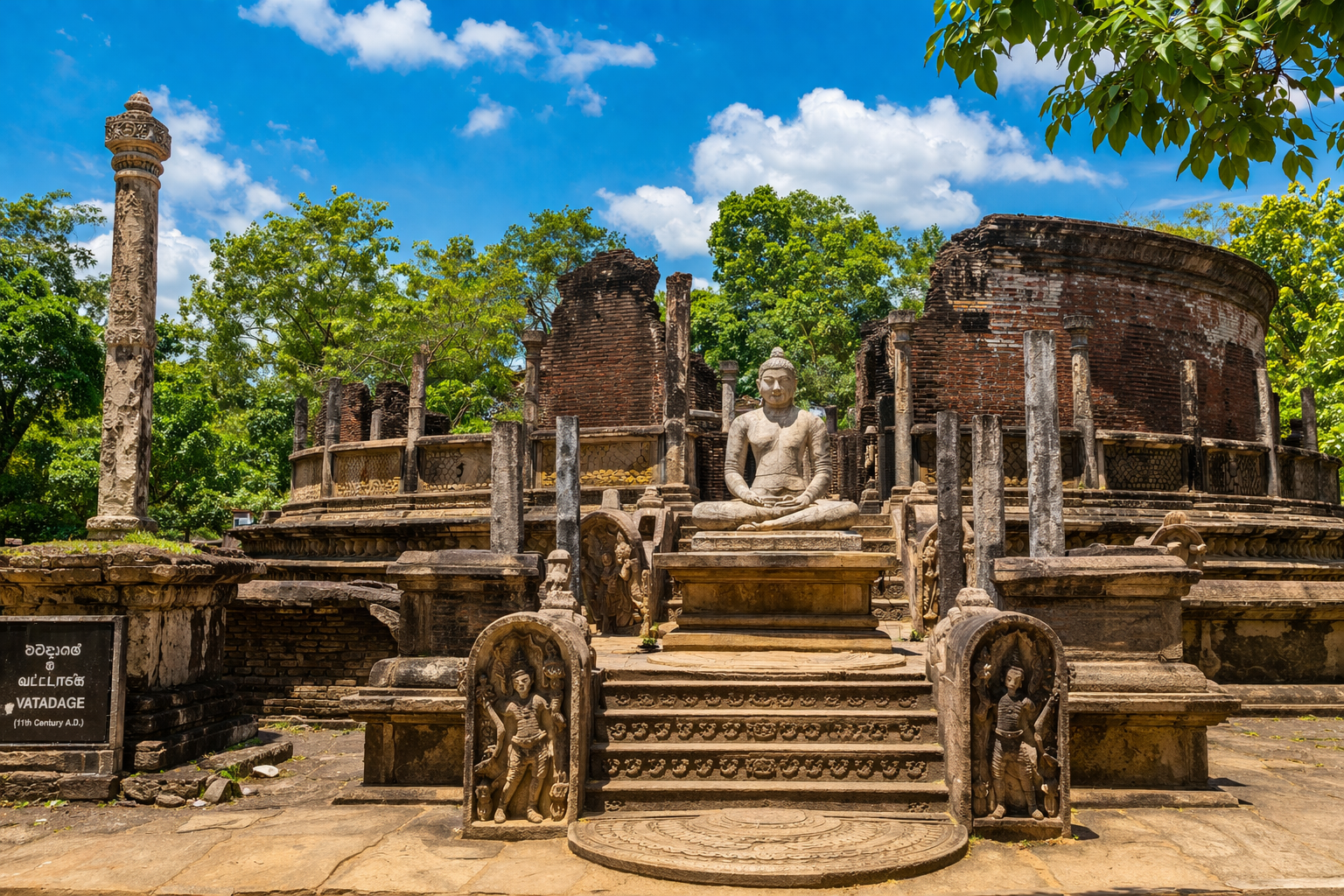
Subsequent kings added to the temple's splendor, continuing to decorate the caves with statues and vibrant frescoes. Today, the complex consists of five separate caves, each filled with its own unique collection of religious art.
The Five Sacred Caves
As you enter the caves, the atmosphere shifts—the tropical heat gives way to a cool, silent reverence. The ceilings and walls are entirely covered in meticulous mural paintings that depict the life of the Buddha, as well as key moments in Sri Lankan history.
Devaraja Lena (Cave of the Divine King)
The first cave houses a colossal 14-meter-long statue of the reclining Buddha, carved directly into the living rock. At his feet stands his favorite pupil, Ananda, and several other deities, creating a scene of eternal peace.
Maharaja Lena (Cave of the Great Kings)
The largest and most impressive is the second cave. It contains 56 statues of various Buddhas, gods, and Sri Lankan kings. Water that drips from a crack in the ceiling is caught in a golden bowl, believed to have miraculous properties, never running dry regardless of the season.
The Golden Temple Below
At the base of the rock stands the modern Golden Temple, a stark contrast to the ancient caves above. It is dominated by a 30-meter-tall gilded Buddha statue in the 'Dhammachakka' (wheel-turning) pose. The temple also houses a museum and serves as the gateway to the uphill climb.
Vistas from the Summit
The climb to the caves is an experience in itself. Along the stone staircase, you are often accompanied by playful monkeys. Upon reaching the top, you are rewarded with a panoramic vista of the surrounding plains. On a clear day, the imposing silhouette of Sigiriya Rock Fortress can be seen rising in the distance, just 20 kilometers away.
Dambulla is a journey into the soul of Sri Lankan Buddhism. It is a place where every brushstroke on the ceiling and every carve in the rock tells a story of devotion, offering a timeless perspective on the island's spiritual heritage.